Territorial and Cultural Entities
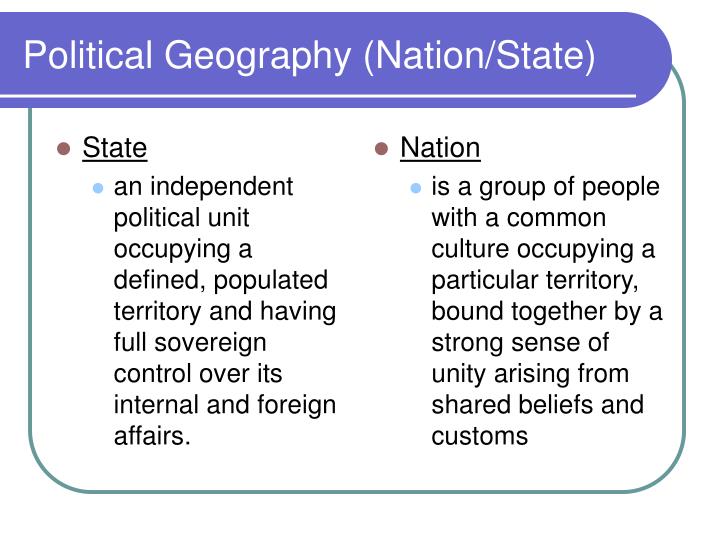
A state is a territorial unit, but a nation is a cultural identity unit. The coupling of the nation-with state is a holdover from feudalism, in which the cultural and economic values of the king or prince were imposed on everyone residing in a territory by its ruler. This caused a common “national” identity to develop. However, national identity, while formed on a territory, can be separated from that territory. German-Americans, Chinese-Americans, and Iranian-Americans retain cultural and economic values that shaped their identities in other territories, even though they move to a different territory.
Should immigrants from one nation-state be forced to drop their previous national identity and adopt a new one? Should they have the right to impose their national values on their new country and demand all the previous residents follow them? Or, should the cultural and economic values of a “nation” be decoupled from the domain of the state where pluralism exists on a territory?
Is the achievement of “e pluribis unum,” from many one, the motto of the United States, possible using the traditional definition of a nation-state? Or, is it only possible if many of the cultural and economic activities associated with a traditional nation-state are decoupled from the state? Under conditions of pluralism, the only viable national (territorial) values undergirding a state have to respect a plurality of identities.
Continue reading →